7th MICCAI Workshop on
“Distributed, Collaborative and Federated
Learning”
In conjunction with MICCAI 2026
Strasbourg, France. September 27 - Octobor 1, 2026
DeCaF page on MICCAI platform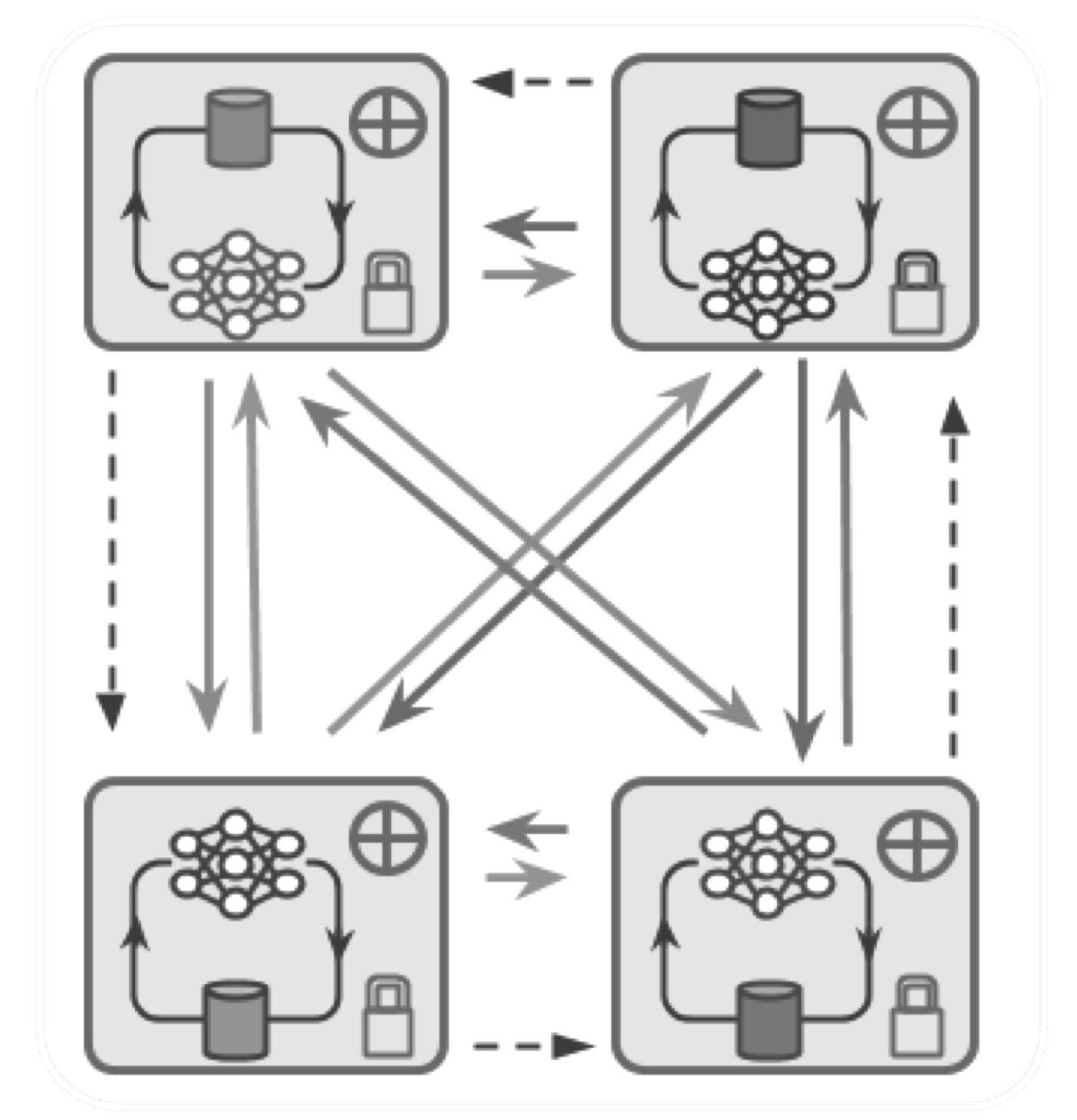
Important Dates
- Submission Deadline: July 1, 2026 July 24, 2026
- Notification of Paper Decisions: July 31, 2026 August
12, 2026
- Camera-ready Paper Due: August 18, 2026
- Workshop will be held on Oct. 1, 2026 at Strasbourg, France.
All deadlines are 23:59 Pacific Time
News
[2026-03] The DeCaF Workshop has been approved for MICCAI 2026
Distributed, Collaborative and Federated Learning
The 7th MICCAI Workshop on Distributed, Collaborative and Federated
Learning (DeCaF 2026) aims to provide a forum to compare, evaluate,
and discuss methodological advances and ideas across federated,
distributed, and collaborative learning, to help move Deep Learning into
the clinical setting while addressing the practical barriers that
currently limit broader deployment.
Deep learning has enabled enormous advances across science and
real-world applications. In medical imaging, however, data sharing
across institutions is often impractical due to strict privacy
regulations and concerns over data ownership. This raises several
critical questions:
- How can we train models collaboratively across sites with
heterogeneous data distributions?
- How can we design and orchestrate multi-agent systems to work
across
institutions without sharing raw data?
- How can collaborative inference strategies make powerful
general-purpose backbones usable despite system heterogeneity?
- How do we ensure data privacy, security, and model fairness?
- How do we handle continual shifts in practice patterns and the
need
for human-in-the-loop learning?
Federated Learning (FL) facilitates collaborative model
training
while keeping raw data localized, supporting diverse regulatory and
organizational settings while producing robust, clinically useful models
without compromising patient privacy.
Diversity, Equity, and Inclusion
The DeCaF organization committee is composed of individuals with diverse backgrounds in terms of seniority in the MICCAI society, career path (academic/industry), gender identities, age, ethno-cultural backgrounds, and countries of origin. We are committed to:
- Encouraging contributions from minorities and all genders
- Balanced speaker selection in terms of expertise and EDI background
- Double-blind reviewing to avoid bias
- Considering EDI factors in final acceptance decisions for similar-quality submissions

Call for Papers
Through the fourth MICCAI Workshop on Distributed, Collaborative and
Federated Learning (DeCAF), we aim to provide a discussion forum to
compare, evaluate and discuss methodological advancements and ideas
around federated, distributed, and collaborative learning schemes that
are applicable in the medical domain.
We welcome contributions around the following and related topics:
- Federated, distributed learning, and other forms of collaborative learning
- Multi-agent collaboration, orchestration, and agentic AI systems in healthcare
- FL techniques for efficient training/fine-tuning of large-scale foundation models (LLMs/VLMs)
- Collaborative inference strategies for distributed model deployment
- Optimization, personalization, and fairness in heterogeneous FL environments
- Impact of data and compute resource heterogeneity in FL
- Privacy-preserving techniques (e.g., secure aggregation, differential privacy) and cybersecurity
- Advanced software platforms, benchmarking, and standardization for real-world FL
- Applications to multi-task learning, meta-learning, and rare disease analysis
- Novel medical datasets and benchmarks for distributed learning research
- Interoperability initiatives across existing FL software libraries
Program (preliminary)
The DeCaF 2026 workshop will be a half-day event featuring:
- Welcome and Opening Remarks
- Keynote Session I (Invited Speakers)
- Oral Session I (Accepted Papers)
- Keynote Session II (Invited Speakers)
- Break / Poster Session
- Keynote Session III (Invited Speakers)
- Oral Session II (Accepted Papers)
- Best Paper Award
- Concluding Remarks
Keynote Session

Evelyn Trautmann
Apheris, Germany

Javier Fernandez-Marques
Flower Labs, UK

Marco Lorenzi
Université Côte d’Azur, France
Meet the Organising Team
Contact: meirui.jiang [at] hotmail.com
Meirui Jiang
Ant Group, China

Xiaoxiao Li
University of British Columbia, Canada

Shadi Albarqouni
University Hospital Bonn | Helmholtz AI, Germany

Spyridon Bakas
Indiana University School of Medicine | MLCommons, USA

Holger Roth
NVIDIA, USA

Alex Karagyris
MLCommons, USA

Yasmeen George
Monash University, Australia

Pramit Saha
University of Oxford, UK

Meet the Outreach Comittee Team
Contact: yuanzhong [at] link.cuhk.edu.hk
Yuan Zhong
Chinese University of Hong Kong, China

Submission
Paper Format: Papers should follow the MICCAI 2026 main conference LaTeX template.
Submission Type: Full papers (up to 8 pages, excluding references).
Submission Platform: OpenReview.
Review Process: Double-blind review with 3 reviewers per submission.
Proceedings: Accepted papers will be published in Springer LNCS as part of MICCAI 2026 Satellite Events proceedings.
Guidelines: Papers must be original and unpublished. At least one co-author must register for the workshop. Papers will be evaluated on technical quality, novelty, and relevance to workshop topics. Outstanding papers will be selected for oral presentation; others for poster presentation